4.2 Corporate Governance Practices
The Corporate Governance Code[42] interprets corporate governance as a notion embracing relationships between executive bodies of a joint-stock company, its Board of Directors, shareholders and other stakeholders. Corporate governance is a tool for identifying firm’s goals and ways to achieve these goals as well as for fostering efficient oversight of firm’s operations for shareholders and other stakeholders.
Core goals of corporate governance are:
- crafting of an effective system for protection and efficient disposal of shareholder’s resources;
- reduction of risks which investors are unable to evaluate and unwilling to accept and management of which by investors in the long run shall inevitably result in reduction of firm’s investment prospects and share prices.
Our corporate governance practices are premised on the principles, described below:
Accountability of the Company’s Board of Directors to all stockholders is statutory and serves as guidance for the Board of Directors in formulating the strategy and administering executive bodies of the Company.
The Company is voluntarily committed to protecting stockholder rights and enforcing equal treatment of all stockholders. The Board of Directors provides all stockholders with an opportunity of viable defense if their rights are disregarded.
The Company enforces just-in-time disclosure of reliable information regarding all corporate events or actions, including but not limited to its financial position, performance, ownership structure and management, and oversees that any stakeholder has an unhindered access to such information.
The Company recognizes its liability to all stockholders of the Company.
In continuously improving its corporate governance practices, the Company closely monitors trends in corporate governance development in Russia. The Company particularly emphasizes the importance of the Corporate Governance Code, adopted in 2014 and recommended for application by the Bank of Russia. The principles and recommendations embedded in the Bank of Russia’s Corporate Governance Code set a high standard and serve as a key benchmark for developing the Company’s corporate governance system. Regulatory requirements also remain under the Company’s close scrutiny and are reflected in its corporate governance practices.
The corporate governance system of PAOPublic Joint-Stock Company Rosseti Ural is based on principles aimed at increasing assets, growing market value, maintaining financial stability and profitability of the Company, and respecting the rights and interests of shareholders and other stakeholders.
Please, visit our official website to examine bylaws regulating corporate governance principles, practices and procedures.
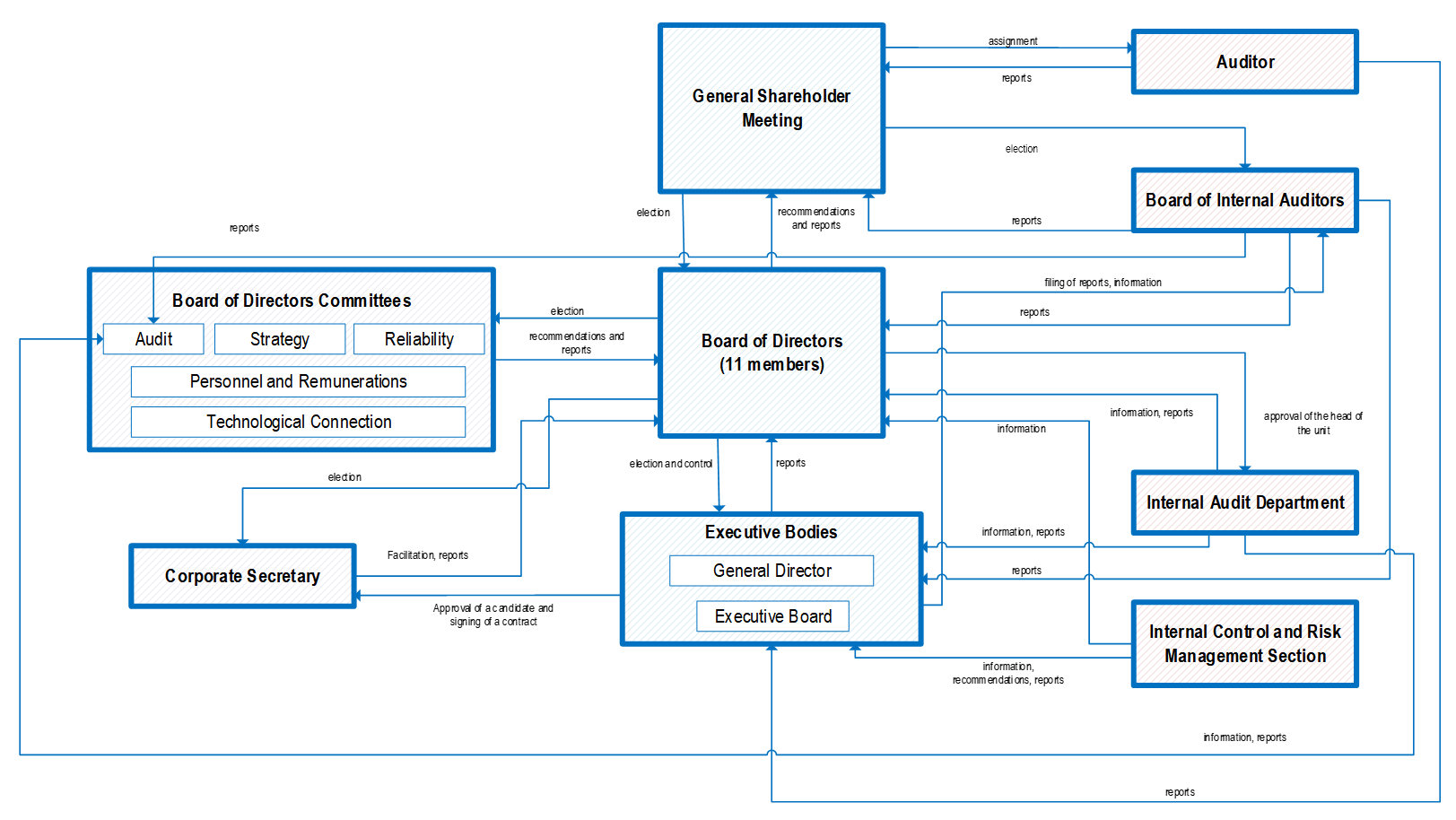
Corporate governance structure
Evaluation of corporate governance level
The Company conducts evaluation of corporate governance practices on an annual basis in compliance with the Methodology[43].
CY2023-2024 and 2024-2025 evaluation of efficiency of corporate governance
| Component |
CY2023-2024 evaluation |
CY2024-2025 evaluation |
|||||
|---|---|---|---|---|---|---|---|
| Number of criteria under evaluation | Largest possible score | Company’s Score | Number of criteria under evaluation | Largest possible score | Company’s Score | ||
| I. | Shareholder rights | 17 | 67 | 63 | 20 | 75 | 71 |
| II. | Board of Directors | 43 | 166 | 113 | 43 | 166 | 113 |
| III. | Executive bodies | 5 | 34 | 28 | 5 | 34 | 20 |
| IV. | Transparency and disclosures | 15 | 133 | 111 | 15 | 133 | 111 |
| V. | Risk management, internal control and internal audit | 16 | 61 | 61 | 16 | 61 | 61 |
| VI. | Corporate social responsibility, business ethics | 6 | 31 | 31 | 6 | 31 | 27 |
| Total score: | 102 | 492 | 407 | 105 | 500 | 403 | |
- Changes in the «Shareholder Rights» component were attributable to the fact that the corporate governance assessment for the 2023–2024 corporate year did not account for matters related to conducting absentee voting for decisions by the Company’s General Meeting of Shareholders, taking into consideration the provisions of Federal Laws[44].
- Changes in the «Executive Bodies» component resulted from the Board of Directors conducting an assessment of executive management effectiveness (including KPIkey performance indicators analysis) on an annual rather than quarterly basis.
- Changes in the «Corporate Social Responsibility, Business Ethics» component were due to the approval of the Personnel and Social Policy in a new edition and the lack of extension of said policy to the subsidiary (a separate order recommended the subsidiary director to develop a personnel and social policy accounting for the specific features of principal business activities).
Following the review of corporate governance assessment results for the 2023–2024 corporate year, the Company in 2025 undertook efforts to organize amendments to the Charter and other internal documents. At the General Meeting of Shareholders held on 23 June 2025, the Charter in a new edition and several internal documents were approved (see «General Meeting of Stockholders» section).
Compliance with the principles of the Corporate Governance Code*
| Aspects | Principles, recommended by the Code | Principles complied with in full | Principles complied with in part | Principles that are not complied with by the Company |
|---|---|---|---|---|
| Rights of stockholders and equal treatment of stockholders in the exercising of their rights | 13 | 13 | 0 | 0 |
| Board of Directors | 36 | 24 | 10 | 2 |
| Corporate Secretary | 2 | 2 | 0 | 0 |
| Remuneration system | 10 | 8 | 2 | 0 |
| Risk Management and Internal Control System | 6 | 6 | 0 | 0 |
| Information disclosure, information policy | 7 | 6 | 1 | 0 |
| Significant and important corporate actions and events | 5 | 2 | 2 | 0 |
| Total | 79 | 61 | 15 | 2 |
The detailed report of PAOPublic Joint-Stock Company Rosseti Ural on compliance with the principles and recommendations of the Bank of Russia’s Corporate Governance Code is presented in the Appendix to the annual report.